Category: Buying Guides

  • Custom Pop Socket Guide: Pricing, MOQs & Lead Times

    If you’ve started pricing out a custom pop socket for a team launch, a conference giveaway, or a retail line, you’ve probably noticed the numbers all over the place — some vendors quote under a dollar a unit, others quote seven dollars, and nobody explains why. The gap comes down to three things: who actually makes the grip, how many you’re ordering, and how the logo gets printed onto that small round base. Get those three variables straight and the pricing stops looking random.

    This guide walks through what a custom pop socket actually costs at different order sizes, what minimum order quantities and lead times look like across the market, and which spec choices (finish, mount type, print method) move the price. The figures below are pulled from current supplier pricing pages so you can sanity-check any quote you’re handed against real numbers.

    Cheapest verified factory-direct price
    $1.28/unit at 1,000+ units
    Lowest advertised entry price
    $0.89/unit (Pinlord)
    Fastest stated lead time
    3-7 business days (PopSockets Corporate Sales)
    Lowest minimum order quantity
    No strict minimum (Pinlord)

    Source: Wholesale Popsockets, Pinlord, and PopSockets Corporate Sales pricing pages, accessed August 2026

    What you’re actually ordering

    “Pop socket” gets used loosely, but there are a few distinct products hiding under that name. The original is a collapsible plastic disc that expands into a grip and folds flat against the phone — that’s the base most bulk suppliers quote by default. PopSockets’ own PopGrip line adds a swappable top that snaps onto a separate base plate, which lets you change designs without buying a new grip each time. Then there’s the MagSafe-compatible PopGrip, which embeds a magnetic ring so it aligns with iPhone wireless chargers and mounts.

    Each version takes a custom pop socket order in a different price direction. A plain swappable-top grip is the cheapest to brand because the print sits on a flat removable disc. A MagSafe version costs more because of the added magnet hardware and the injection-molded housing that holds it. Metal or enamel-finish grips — sold as a premium line by PopSockets and a few licensed printers — cost more again because they’re stamped and filled rather than printed.

    Before you request quotes, decide which of these three you actually need. A trade-show giveaway rarely needs MagSafe compatibility; a retail product line aimed at iPhone 15/16 buyers probably does.

    How much a custom pop socket actually costs

    Pricing splits cleanly into two markets. Factory-direct manufacturers sell in bulk tiers and charge close to production cost once you’re past a few hundred units. Branded promotional distributors — the companies that show up first in search results with logo mockup tools — mark the same grip up substantially because they bundle in design proofing, account service, and smaller minimums.

    On the factory-direct side, Wholesale Popsockets prices a custom pop socket at $1.88 per unit for 250–499 pieces, dropping to $1.48 at 500–999 pieces and $1.28 at 1,000–2,499 pieces — a 32% drop in per-unit cost between the smallest and largest of those three tiers. On the distributor side, WizardPins quotes $7.23 per unit at its 100-unit minimum, falling to $6.13 per unit at 7,500 units, while Quality Logo Products lists standard custom PopSocket models between $4.98 and $5.30 per unit regardless of exact quantity within its normal ranges.

    The practical takeaway: if you’re ordering under 250 units, a distributor’s lower minimum usually wins even though the unit price is higher, because factory-direct suppliers often won’t take an order that small at all. Past 500–1,000 units, factory-direct pricing pulls well ahead.

    Per-unit price for a factory-direct custom pop socket falls 32% from the 250-unit tier to the 1,000-unit tier250-499 units: $1.88; 500-999 units: $1.48; 1000-2499 units: $1.28250-499 units$1.88500-999 units$1.481000-2499 units$1.28
    Per-unit price for a factory-direct custom pop socket falls 32% from the 250-unit tier to the 1,000-unit tierSource: Wholesale Popsockets pricing page (wholesalepopsockets.com), accessed August 2026

    Minimum order quantities and lead times by vendor

    Minimum order quantity is the other number that decides which supplier fits your order, and it varies more than the price does. PopSockets’ own corporate sales program sets a 120-unit minimum with a stated 3–7 business day turnaround, which is fast for a custom run but assumes standard artwork with no special finishes. WizardPins starts quoting at 100 units but runs a longer 2–3 week production cycle. Pinlord advertises no hard minimum and a starting price near $0.89 per unit, with average turnaround around 10 days, which makes it a reasonable option for small test batches or sample runs before committing to a bigger order.

    None of these numbers include shipping transit time, and none account for the extra 2–3 days that full-bleed edge-to-edge printing typically adds over centered artwork that leaves the border unprinted. If your event date is fixed, build in a buffer past the quoted production window rather than working backward from the ship date the vendor gives you at checkout.

    Minimum order quantity and lead time vary more between vendors than price does
    Supplier Entry MOQ Price at Entry MOQ Stated Lead Time
    WizardPins 100 units $7.23/unit 2-3 weeks
    PopSockets Corporate Sales 120 units Custom quote 3-7 business days
    Pinlord No strict minimum (~50 units typical) From $0.89/unit ~10 days
    Minimum order quantity and lead time vary more between vendors than price doesSource: WizardPins, PopSockets Corporate Sales, and Pinlord vendor pages, accessed August 2026

    The flat circular top of a pop socket is small — usually just over an inch across — which limits how a design gets applied. Full-color dome printing (sometimes called UV printing) lays ink directly onto the plastic and seals it under a raised, glossy resin dome. It reproduces photos and gradients accurately and holds up to years of thumb contact and pocket friction, which is why it costs more than flat printing. Spot-color or single-layer imprint is cheaper per unit but shows wear at the edges faster, especially on grips that get handled dozens of times a day.

    Enamel and metal-finish grips take a different route entirely: the design is stamped into metal and the recessed areas are filled with colored enamel, similar to a lapel pin. That process produces the most durable finish available but restricts you to solid color blocks rather than photographic detail, and it costs meaningfully more than either printing method.

    If durability matters more than exact color matching — a company logo that needs to survive two years of daily use, for instance — enamel is worth the premium. If you need a photo, gradient, or gradient background reproduced accurately, dome printing is the only realistic option.

    Choosing the right supplier for your order size

    Match the supplier to the order, not the other way around. Under 100 units — a sample run, a small team, a one-off gift batch — a no-minimum shop like Pinlord keeps you from overpaying for capacity you don’t need. Between 100 and 500 units, a promotional distributor with an established proofing process is usually worth the higher per-unit price, because you’re getting design support and a single point of contact if something prints wrong. Past 500–1,000 units, request quotes directly from factory-direct manufacturers; the per-unit savings compound quickly and most of them will still assign a production contact for orders that size.

    Whatever the quantity, ask two questions before you place the order: what the return policy is if the print comes out misaligned or the color is off, and whether the quote includes a physical proof or only a digital mockup. A digital mockup tells you nothing about how the ink will actually look on the domed plastic surface — colors shift once they’re under resin, and a $15–$30 physical sample avoids finding that out on a 1,000-unit run.

    Frequently asked questions

    What’s the minimum order quantity for a custom pop socket?

    It depends on the vendor. Factory-direct manufacturers commonly start around 250 units. Promotional distributors like PopSockets’ own corporate sales program set a 120-unit minimum, and a few print shops such as Pinlord advertise no strict minimum, which suits sample runs or very small batches.

    How much does a custom pop socket cost per unit?

    At factory-direct pricing, expect $1.28–$1.88 per unit depending on quantity tier (250 to 2,500+ units). Through a branded promotional distributor, expect $4.98–$7.23 per unit for comparable quantities, since the price includes design proofing and smaller minimums.

    How long does production take for a custom pop socket order?

    Most suppliers quote 3-7 business days after you approve the final art proof. Some smaller print shops run 10 days to 2-3 weeks. Full-bleed, edge-to-edge designs typically add 2-3 days over centered artwork that leaves a border.

    Do MagSafe-compatible pop sockets cost more to customize?

    Yes. The magnetic ring and reinforced housing needed for MagSafe compatibility add cost over a standard swappable-top grip, and customization is usually limited to the swappable top disc rather than the full unit.

    Should I order a physical sample before a bulk run?

    For any order over a few hundred units, yes. Colors and fine detail can shift once ink is sealed under the resin dome, and a digital mockup won’t show that. A physical proof typically costs far less than reprinting a bulk order that came out wrong.

    The bottom line

    The spread in custom pop socket pricing isn’t arbitrary — it tracks order size, print method, and whether you’re buying from a factory-direct manufacturer or a full-service distributor. For most first-time orders, that means starting small with a no-minimum or low-minimum supplier to test a design and finish, then moving the bulk of the order to a factory-direct vendor once you know the specs are right. Get a physical proof before any run past a few hundred units, and build a few extra days into your timeline beyond whatever lead time the vendor quotes at checkout.
  • Custom Phone Grips: Materials, Sizing & Branding Guide

    Custom Phone Grips: Materials, Sizing & Branding Guide

    Custom Phone Grips: A Materials, Sizing, and Branding Guide

    Getting custom phone grips right comes down to three decisions: the material, the size or spec, and how you brand them. Make those well and you end up with custom phone grips that protect and present your product, reinforce your brand, and land on budget. This guide walks through the material options, how to size and spec your order, and how to decorate custom phone grips so they do real work for your brand rather than just checking a box.

    Whether you are ordering your first run or reordering at scale, the same fundamentals apply. Choosing custom phone grips deliberately — material to job, size to product, decoration to brand — is what separates an order you are proud of from one you settle for.

    Why custom phone grips matter for your brand

    Custom phone grips are more than a commodity; they are a touchpoint brands experience directly. A well-chosen, well-branded option signals quality and attention to detail, while a generic one quietly undercuts an otherwise strong product. Because custom phone grips are seen and handled, they carry your brand into the world every time they are used.

    That visibility is exactly why it pays to spec custom phone grips intentionally. The material sets the feel, the size sets the fit and cost, and the decoration sets the impression — and getting all three aligned turns a functional item into a genuine brand asset.

    Materials and options compared

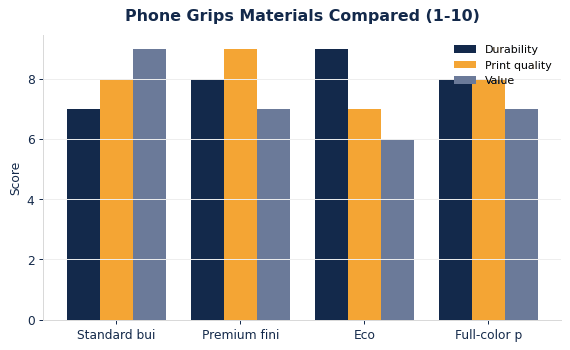
    The common materials for custom phone grips each trade off durability, print quality, and cost: standard build, premium finish, eco / recycled, and full-color print surface. The right pick depends on how the phone grips will be used, the look you want, and your budget. The chart and table below compare the main options so you can match material to job.

    How common phone grips materials compare on durability, print quality, and value.
    How common phone grips materials compare on durability, print quality, and value.

    As a rule of thumb, choose a recyclable or natural material when eco positioning matters, a coated or laminated option when you want vivid full-color print, and a premium build when the phone grips is part of a gift or high-end presentation. When in doubt, request a sample so you can judge feel and print before committing to a full run.

    Material / option Best for
    Standard build reliable, cost-effective for high-volume swag
    Premium finish soft-touch or upgraded feel for gifting
    Eco / recycled sustainable option that signals brand values
    Full-color print surface vivid, edge-to-edge branding area

    Sizing and specs

    Sizing is where many phone grips orders go wrong, so measure before you order. Custom phone grips typically range from a compact giveaway up to a larger statement piece, and the right size and format depends on the product or use they serve. Too small and the fit is tight or the product is exposed; too large and you pay for material you do not need and lose a clean, intentional look.

    When a measurement falls between standard options, size to the product with a small margin rather than guessing. Confirming the size and format on a proof or sample before a large run prevents the costly mistake of a full order that does not fit, which is far more expensive to fix than a five-minute check up front.

    Branding and decoration

    Decoration is what turns a plain phone grips into a branded one. Pad printing and full-color wraps place logos vividly, with engraving or embossing for an upscale, permanent mark. Match the method to your artwork and budget: simple logos reproduce cleanly and cheaply, while detailed, full-color designs shine with the right process on the right material. Keep the artwork vector where possible and confirm the print area for your chosen size.

    Restraint usually reads as premium. A clean logo, one or two brand colors, and quality material almost always look more considered than a busy, over-printed design. Approving a proof before the run protects both the look and the budget, especially on a large order of custom phone grips.

    Ordering and budget

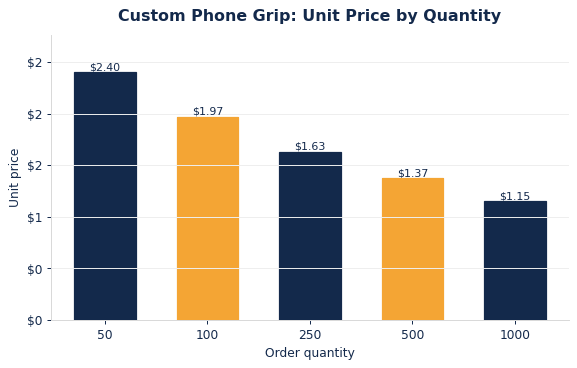
    Per-unit cost on custom phone grips falls steadily with volume as setup amortizes across more pieces, so ordering for real demand rather than a token first batch is usually the efficient move. The curve below shows how pricing typically improves with quantity, which helps you plan an order that balances cash and cost.

    Typical per-unit phone grips pricing as order quantity increases.
    Typical per-unit phone grips pricing as order quantity increases.
    Ordering for a recurring need? A single larger run lowers the unit cost and keeps your branding consistent, while a small overage covers reorders and the occasional damaged piece without a rush order.

    Common mistakes to avoid

    A few avoidable missteps account for most disappointing phone grips orders. Ordering before measuring is the biggest, followed by choosing a material for price alone without considering how the phone grips will actually be used, and skipping the proof on a large run. Each is easy to prevent with a few minutes of planning, and each is expensive to fix once a full order is produced.

    The other common trap is over-designing the artwork. Cramming in too many colors, effects, or details can muddy the print and raise the cost, especially on textured or recycled materials. Simplifying the design to a clean, legible mark almost always improves both the look and the price of your custom phone grips.

    Frequently asked questions about custom phone grips

    What material is best for custom phone grips?

    It depends on the use: choose a recyclable or natural material for eco positioning, a coated or laminated option for vivid full-color print, and a premium build for gifting or high-end presentation. Request a sample to judge feel and print before a full run of custom phone grips.

    How do I choose the right size?

    Measure the product or use the phone grips serves, then size to it with a small margin so the fit is clean without wasting material. When a measurement falls between standard options, size up slightly and confirm the size and format on a proof before ordering in volume.

    How are custom phone grips branded?

    Pad printing and full-color wraps place logos vividly, with engraving or embossing for an upscale, permanent mark. Match the method to your artwork and budget, keep the art vector where possible, confirm the print area for your size, and approve a proof so the finished custom phone grips match your intent.

    How does pricing work, and is there a minimum?

    Per-unit cost drops with quantity as setup amortizes across the run, so larger orders are more cost-effective. Order for real demand plus a small overage rather than a token batch, and consolidate recurring needs into one run for the best price.

    Can I get a sample or proof before ordering?

    Yes, and it is strongly recommended. A physical sample lets you judge material and print, and a digital or physical proof confirms your artwork, color, and size and format before a full run — a small step that prevents a costly mistake on a large order.

    What do you need to quote custom phone grips?

    To quote accurately we need the size and format or the product they serve, the quantity, your material preference, and your artwork or a description of the branding. With those details we can recommend the right material and size and give you pricing for the run, and a proof follows once the order is confirmed.

    Whatever you order, send vector artwork, confirm material and size and format, and approve a proof before production. For help matching custom phone grips to a specific use, see our companion guide, our How to Choose Custom Phone Grips for Your Brand, and explore our our shop to start your order.

    Ready to order custom phone grips?

    Tell us your product, quantity, and branding and we’ll match the material, size, and decoration for you.

    Get a Quote

  • Custom PopSockets: A Buyer’s Guide for Promo, Events & Brand Merch

    Custom PopSockets: A Buyer’s Guide for Promo, Events & Brand Merch

    Call or Text us: (929) 605-4397

    Custom PopSockets: A Buyer’s Guide for Promo, Events & Brand Merch

    Few giveaways earn a permanent spot on the one object people touch a hundred times a day, which is exactly the pitch for custom popsockets and phone grips: your logo rides on the back of a phone, into every meeting, coffee shop, and photo the owner takes. For marketing teams, event planners, campus organizations, and merch lines, the buying decisions are authenticity versus generic grips, print method, packaging, and quantity. This guide walks through how to order custom popsockets that people actually keep on their phones, instead of the drawer where weak promo goes to die.

    Genuine vs. Generic Grips: What You Are Really Paying For

    The first decision is brand-name PopSockets (PopGrip line, via corporate programs) versus generic collapsible grips. Genuine units cost two to four times more but carry the swappable top system, stronger adhesive rated for repeated repositioning, and the name recipients recognize; the mechanism survives thousands of collapse cycles. Generic grips have improved and are entirely respectable for high-volume events, but adhesive quality varies wildly between factories, and a grip that falls off a phone case takes your logo with it. If the audience is clients, employees, or anyone whose opinion compounds, buy genuine; if you are seeding a 5,000-piece conference bag, a well-vetted generic with a tested adhesive is the rational pick.

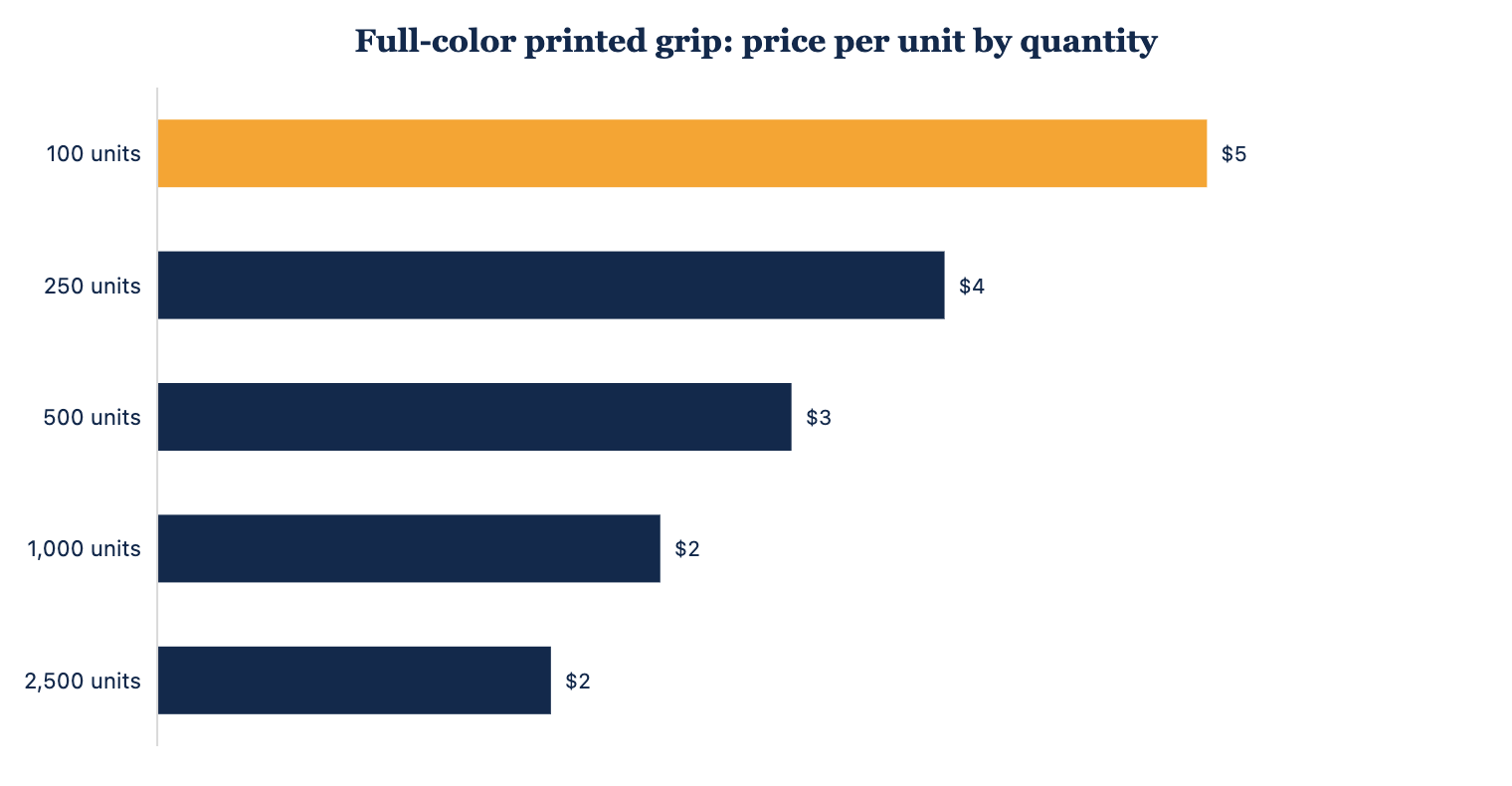
    Typical per-unit price for printed phone grips at rising quantities.
    Typical per-unit price for printed phone grips at rising quantities.

    Print: Small Canvas, Unforgiving Detail

    The printable face is a 38–40 mm circle, and artwork that works on a tote dies on a coin-sized disc. Full-color UV printing is standard and handles gradients and photos well; the failure mode is fine text, which turns to mush below about 6 pt. A simplified logo mark, an icon, or a bold monogram outperforms a full lockup with a tagline every time. Gloss faces pop colors; matte faces hide fingerprints and read more premium. For dark artwork, ask for a white ink underlayer, or colors will sink into the base plastic and look bruised.

    If the campaign has a hashtag or QR destination, print it small on the disc edge card rather than the face; the face belongs to the mark people are willing to display in public.

    Test on a case, not a bare phone

    Most phones live in cases, and most adhesion complaints trace to textured or silicone cases rather than the grip itself. Sample your grip on the three most common case types in your audience before committing, and include a one-line “press firmly for 12 hours” card in the packaging; that single sentence prevents most day-one failures.

    OptionTypical unit cost (500 pcs)Adhesive qualityBest for
    Genuine PopGrip$7.00–$10.00Excellent, swappable topClients, employees, retail merch
    Premium generic$2.50–$4.00Good, test per factoryConferences, campus, promos
    Budget generic$1.20–$2.50VariableMass giveaways
    Grip + wallet or stand combo$4.00–$7.00GoodHigher-perceived-value gifts

    Color strategy on grips is simpler than most merch: the base disc comes in dozens of stock colors, so match the disc to your brand color and keep the printed face clean rather than flooding the print with a background. A brand-color base with a white or single-color mark costs nothing extra and survives scuffing better than heavy ink coverage, which can chip at the edges after months of pocket wear.

    Where Grips Work Hardest

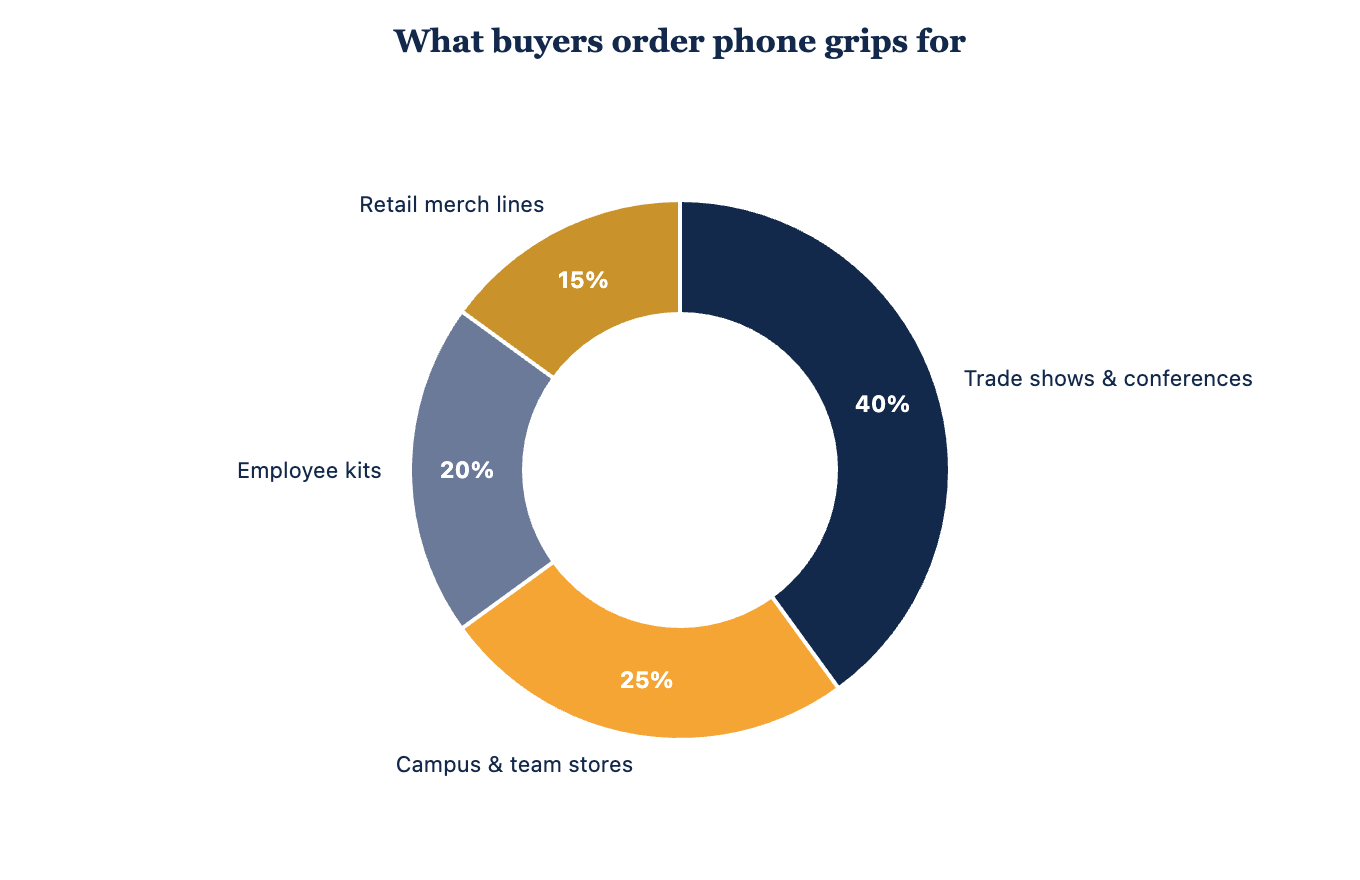
    The donut below shows how orders split by use case. Trade shows and conferences dominate because grips beat pens and stress balls on every retention metric that matters; campus and team stores follow, where school marks turn a grip into low-cost spirit merch; employee onboarding kits and retail merch lines round out the mix. One planning note for events: grips hand out fastest when staff demonstrate the collapse mechanism, so brief the booth team, because a demonstrated grip goes on a phone that night while a bagged one risks the drawer.

    Typical order split across phone grip use cases.
    Typical order split across phone grip use cases.

    Consider function upgrades where the audience justifies them: grips that double as phone stands earn desk time in video calls, magnetic-compatible rings suit iPhone-heavy audiences, and swappable-top systems let you refresh the design without replacing the base. Each upgrade adds a dollar or two; each also gives the recipient one more reason to keep the grip when they eventually change phone cases.

    Tip: Order a 10-piece sample run with your actual artwork before the main order. Logo legibility at 40 mm, color accuracy over the base plastic, and adhesive behavior on real cases are all judgment calls no digital proof can make for you, and samples typically add only a week.

    Distribution strategy affects how many you actually need. Booth giveaways see 20–40% wastage to casual grabbers, so order to your qualified-lead forecast rather than raw foot traffic; grips handed over during a demo or included in a follow-up mailer convert to phones at several times the rate of fishbowl swag. For campus stores, start with a modest run per design and read sell-through, because grip designs behave like apparel graphics: one or two will dominate and the rest will need a clearance bin.

    Packaging, Quantities, and Timing

    Packaging sets perceived value: a printed backing card with a euro hook turns a loose grip into retail-ready merch and roughly doubles the branded surface, while polybagged bulk packing suits conference tables. Individually boxed genuine units make convincing employee gifts. On quantities, price breaks land at 100, 250, 500, and 1,000; most event orders settle at 250–500 pieces, and per-unit pricing drops steeply through that range, as the pricing chart shows. Standard production plus shipping runs two to three weeks for generics and three to four for genuine corporate programs, so start a month out from any hard date, and add a week whenever a sample approval sits in someone’s inbox.

    Finally, keep a small evergreen stock. Grips are light, non-perishable, and cheap to store, so a spare box of 100 in the marketing closet turns every unexpected visitor, new hire, or last-minute event into a covered moment without a rush order.

    The Bottom Line

    Match genuine versus generic to how much the audience’s opinion matters, simplify the artwork until it reads at arm’s length, test adhesive on real cases, and package for the context. Custom popsockets are one of the few promo items with a daily-touch habit built in; spec them properly and your logo earns hundreds of impressions per recipient per week, indefinitely, for a few dollars once.

    Planning a grip order?

    Tell us your audience, quantity, and artwork, and we will recommend genuine or generic, print spec, and packaging with exact pricing.

    Get a Quote

    Home · About · Browse grip styles on our homepage or see how we print custom popsockets.