Nothing undermines a custom phone grip faster than one that will not stay put. A brand spends on artwork, orders a few hundred grips for an event, and then hears that they peeled off in a pocket by lunchtime. The culprit is almost never the grip itself; it is the surface it was asked to stick to. Adhesive phone grips are only as good as the bond underneath them, and that bond is decided by the phone case, not the grip. Before you finalize an order, it is worth understanding which surfaces hold, which fight you, and what to do when your audience is carrying the difficult ones.
The single biggest reason grips fall off
Adhesive grips rely on a pressure-sensitive adhesive that needs a smooth, rigid, clean surface to grab. The most common failure is the silicone or soft-touch rubber case, which is exactly the kind of case a large share of people already own. Silicone is flexible and naturally oily at the surface, so the adhesive never forms a lasting bond; the case also flexes as the phone is handled, which slowly works the grip loose. This is not a defect in the grip. It is a material mismatch, and it is predictable enough that you can plan around it instead of discovering it after the giveaway.
Surfaces that hold and surfaces that fight you
Hard cases are where adhesive grips do their best work. A rigid polycarbonate or hard plastic case gives a flat, non-flexing surface that the adhesive can lock onto, and it is the most reliable target of all. A bare glass phone back or a glossy tempered-glass-backed case also bonds well because glass is smooth and rigid, and a smooth leather case holds better than most people expect for the same reason. The surfaces that fight you are the soft and the rough ones: flexible silicone and rubber, matte or soft-touch coated finishes that feel grippy in the hand, heavily textured or patterned cases, and some coated or water-resistant shells whose slick surface treatment repels adhesive. If your audience skews toward any of those, direct adhesive is the wrong plan.
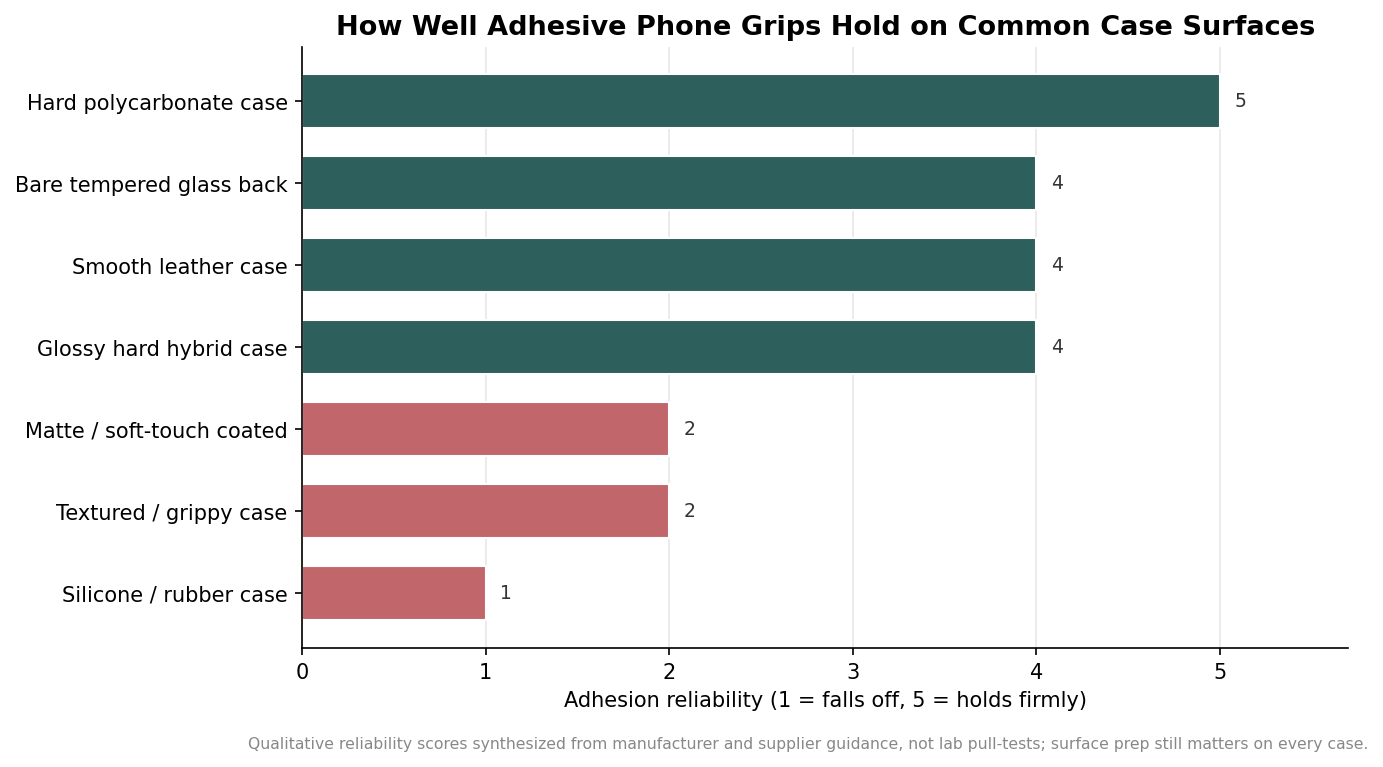
Preparation buys you a better bond
Even on a friendly surface, how the grip goes on decides how long it stays. The adhesive works best on a surface wiped clean with isopropyl alcohol and allowed to dry, which strips away the skin oils and case-coating residue that quietly weaken the bond. Press the grip down firmly and then leave it alone: most adhesive grips are designed to be pressed once and given time to set rather than repositioned repeatedly, and repeated peeling to adjust placement is a reliable way to kill the adhesive early. As a general rule for pressure-sensitive adhesives, plan on roughly an hour before the grip is put under load and a few days before it reaches full strength, and tell recipients not to test it by yanking it the moment it is applied. It also helps to place the grip in the lower center of the case rather than over a seam, a camera bump, or a curved edge, because any gap under the adhesive footprint becomes the point where peeling starts. Where the grip sits is as much a part of a lasting bond as what it sits on.
What to do when the case won’t cooperate
When your audience carries soft or textured cases, you have three sensible routes, and the right one depends on how the grip will be used. The simplest fix keeps direct adhesive but adds a thin rigid backer plate, an adhesive disc that sticks to the soft case and presents a hard, flat surface for the grip; it rescues silicone cases and makes the grip swappable, at the cost of an extra component. The cleaner modern answer is a MagSafe or magnetic grip that snaps onto a magnet-compatible case or ring and skips adhesion entirely, which also lets the user pop it off for wireless charging and reposition it endlessly. Direct adhesive remains the cheapest and lowest-friction option, but it is the least forgiving on the exact cases most likely to be in the room.
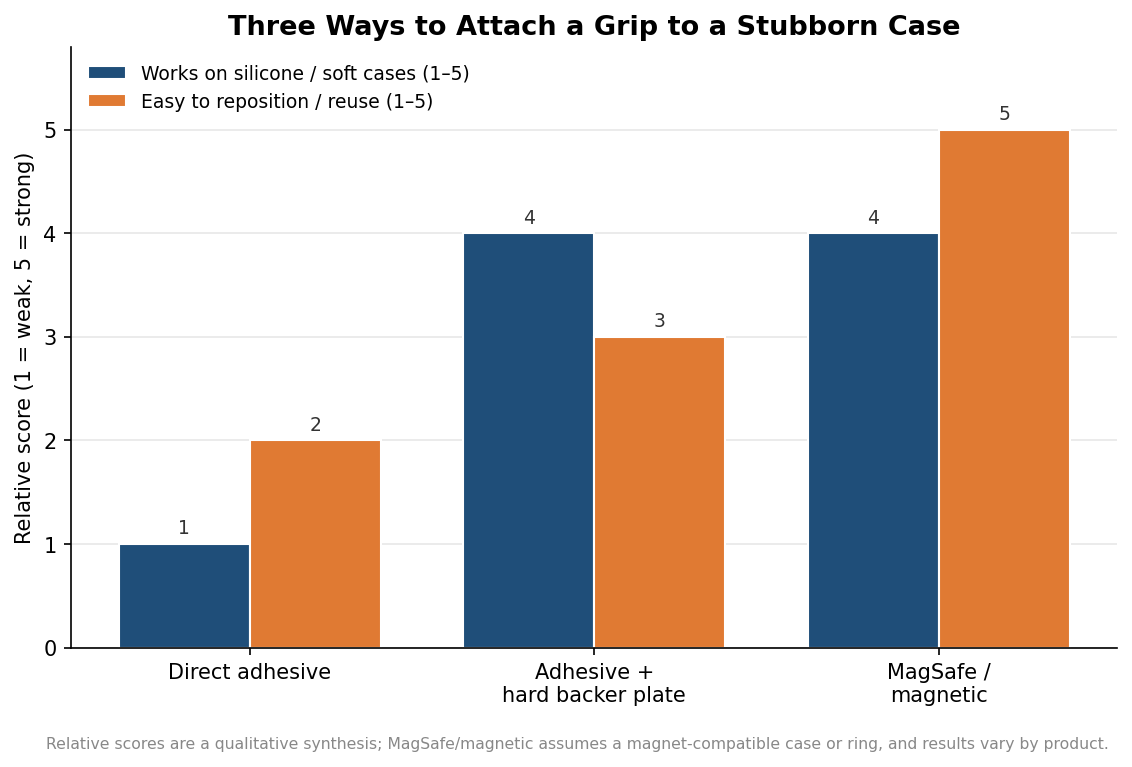
The comparison above is a qualitative one rather than a set of lab measurements, and the magnetic route assumes the case actually carries a magnet array or ring, so treat it as a way to narrow the choice rather than a final verdict. For a mixed crowd, a magnetic grip covers the widest range of phones without the silicone problem, while a straightforward hard-case audience is well served by ordinary adhesive.
Specify the surface before you order
The practical takeaway is to decide the attachment method as deliberately as you decide the artwork. If you are handing grips to a known group on newer iPhones, magnetic makes sense; if you are seeding a broad promotional audience whose cases you cannot predict, either build in backer plates or accept that a share of silicone-case users will need help. Ask your supplier which adhesive they use and whether a magnetic or swappable version of the same printed design is available, because the print is identical across formats and only the base changes. Getting the base right is what turns a good-looking grip into one that is still on the phone a month after the event, doing the quiet advertising you paid for.
Leave a Reply