The word “phone grip” covers at least four different mechanisms, and they do not hold a phone the same way, brand the same way, or price out the same way. If you are ordering a few hundred or a few thousand with a logo on them, the style you pick decides how much usable print space you get, whether the grip survives a wireless charger, and what you pay per unit. This is a side-by-side look at the expanding button, the finger ring, the elastic strap, and the kickstand plate, aimed at a buyer specifying a branded run rather than shopping for one at retail.
The four grip styles and how they actually hold a phone
The expanding button is the accordion-style grip most people picture: a round top on a collapsible stalk that pops out from an adhesive or magnetic base. You hold it between two fingers, and because the stalk collapses, the same part folds down to prop the phone up as a stand. The finger ring is a metal or plastic loop on a hinged plate; you slip one finger through it and it rotates flat against the back, then folds out to act as a landscape kickstand. The elastic strap is a flat band bonded to a thin baseplate; your fingers slide under the band, and the whole thing sits only a few millimeters proud of the case. The kickstand or wallet plate is a larger flat panel with a fold-out leg, often magnetic, that trades pocketability for a bigger stand and, sometimes, card storage.
Those mechanical differences matter before you get anywhere near artwork. A grip that a user grabs dozens of times a day has to hold its adhesion and its hinge, and the failure points differ by style: expanding buttons wear at the collapsing joint, rings loosen at the hinge, and straps depend entirely on the bond between band and plate.
Wireless charging and MagSafe: the compatibility question
This is the first thing to settle, because it quietly rules out options. A standard adhesive grip stuck to the center of the back will block a Qi charging coil and will not sit on a MagSafe puck. Three ways around it show up in the market. The thinnest, flattest styles, especially elastic straps, can be positioned low on the case so the charging coil stays clear. Removable grips let the user pop the grip off the base to charge, then reattach it. And MagSafe-native grips build the magnet array in, so the grip snaps onto the ring and passes the phone through to a MagSafe charger, or lifts off cleanly.
If your recipients are the kind of people who charge on a pad or in a car mount, specify a MagSafe or removable design and say so on the product page, because a grip that forces someone to choose between holding the phone and charging it tends to end up in a drawer. Expect a MagSafe build to cost meaningfully more than a plain adhesive one, which the pricing below reflects.
Branding area and decoration by style
Print area is where the styles diverge most for a marketer. The expanding button gives you a clean, round canvas on the top disc, usually around a 38 to 40 millimeter circle, which works out to roughly 11 to 12 square centimeters of unobstructed space, ideal for a centered logo. A finger ring hides most of its surface in the loop and hinge, leaving only a small baseplate, so you are often working with a fraction of that. An elastic strap prints along the band and sometimes the plate underneath, a long narrow area that suits a wordmark better than a detailed emblem. A kickstand or wallet plate has the largest flat back of the group and can carry a full-bleed design, which is why it is a favorite for bold, edge-to-edge branding.
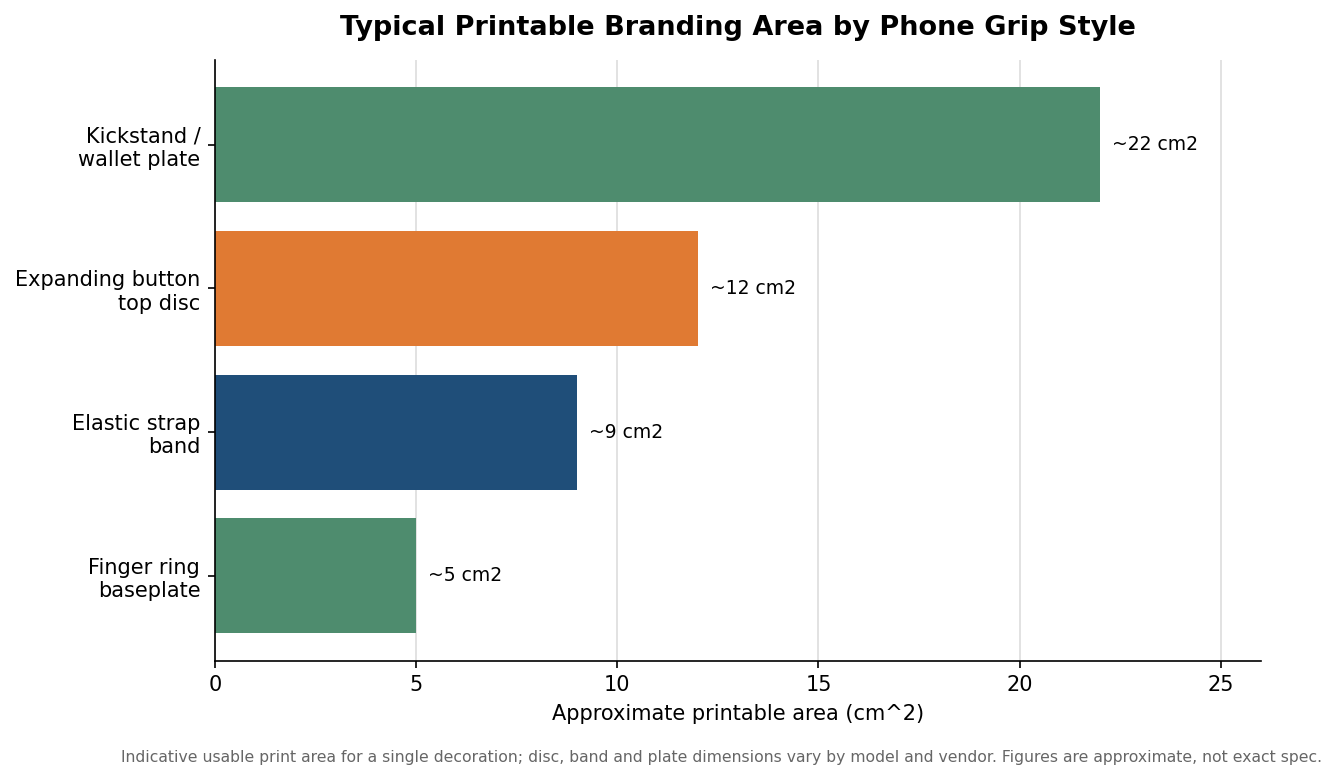
Decoration method interacts with these areas. Full-color printing, whether UV or a printed insert under a lens, needs a flat, reasonably large area, so it flatters the button top and the wallet plate. Small ring baseplates and curved surfaces are better suited to a one-color mark or a molded detail. Treat the numbers above as indicative rather than exact, because disc diameters, band lengths, and plate sizes vary from one manufacturer to the next.
Cost and minimums by quantity
Custom grips follow the same curve as most promotional products: the per-unit price falls as the quantity climbs, and the decoration and any premium hardware set the floor. The chart below shows indicative US ranges for two tiers, a standard adhesive grip and a MagSafe or authentic-brand premium grip, across common order sizes.
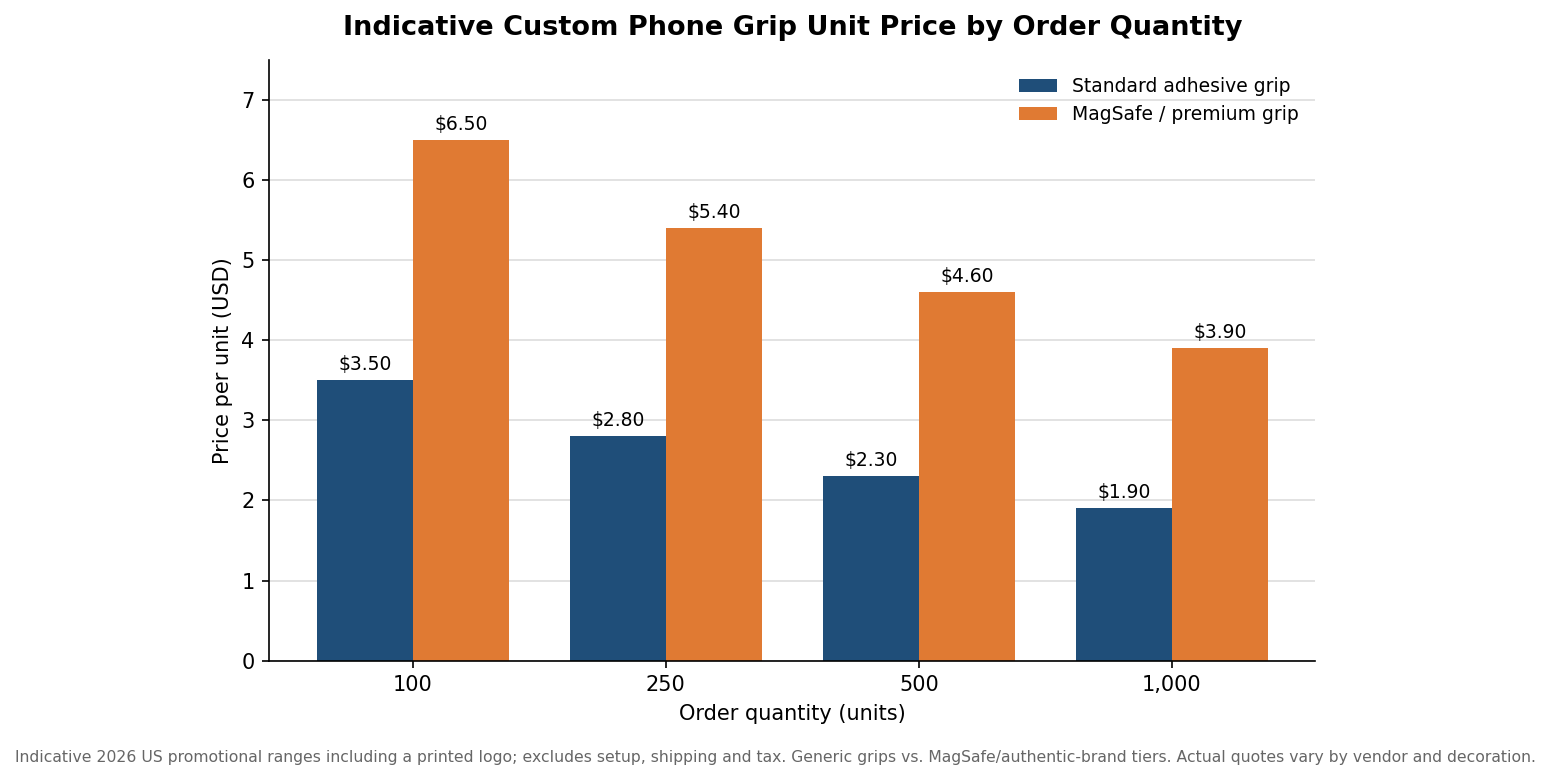
A few practical notes sit behind those bands. Minimums commonly start around 100 to 250 units for generic grips, and authentic branded platforms often set their floor higher. The first price break usually lands between 250 and 500 units, so if you are hovering just under a break, pricing a slightly larger run is worth doing. Setup or plate charges, full-color versus one-color decoration, and shipping all sit on top of the unit price, and rush timelines carry their own premium. The figures here exclude those add-ons and are meant to frame a budget, not to quote a job.
Matching the style to the campaign
Once compatibility and budget are settled, the style almost picks itself from the use case. For a broad giveaway where a recognizable logo matters most, the expanding button’s round top is the safe canvas. For a tech-savvy audience that lives on wireless charging, a MagSafe or strap design avoids the drawer. For premium gifting or a product launch where the packaging and the print both need to look considered, a wallet or kickstand plate gives you the real estate and the perceived value. And for the thinnest, most pocket-friendly option that still adds a hold, the elastic strap wins on profile even though it gives up the stand function. Decide the mechanism first, confirm it survives your recipients’ charging habits, then let the print area and the quantity break guide the final call.
Leave a Reply