On the day they arrive, three custom phone grips printed three different ways can look nearly identical. The difference shows up months later, in a car cupholder or a coat pocket, when one grip’s artwork is still crisp and another has started to peel at the edge or fade. How a grip is decorated, not just what it looks like in the mockup, is what decides whether your logo is still legible after a summer of daily use. For a promotional product whose whole job is to keep a brand in someone’s hand, that longevity is the spec that matters most.
Three ways a phone grip gets its image
Nearly all custom phone grips are decorated by one of three methods. Sublimation uses heat to infuse the dye directly into the surface of a rigid acrylic top, so the image becomes part of the material rather than a layer sitting on top of it. Digital or UV inkjet prints the artwork onto the acrylic surface, which gives a very wide color range and the fastest turnaround, usually with a clear topcoat added for scratch resistance. Vinyl decal laminates a thin printed film onto a generic grip base; it is the cheapest route and fine for a short-lived campaign, but the film is a separate layer that can lift over time. All three can look sharp in a photo, so the choice is really about how the image is bonded to the grip, not how it prints on day one.
Durability is where the methods split apart
The gap between the methods is small at first and large over time. Because sublimation dye lives inside the acrylic, it resists fading under UV light and survives the repeated collapse-and-expand cycle of the grip mechanism without wearing, holding up past several hundred expansions. Inkjet prints protected by a topcoat typically look good for something on the order of six to nine months of daily use before the surface starts to show wear. Vinyl decals are the most exposed: the laminated film is prone to edge lifting after roughly three to four months, and it degrades faster near heat, such as a dashboard on a hot day.
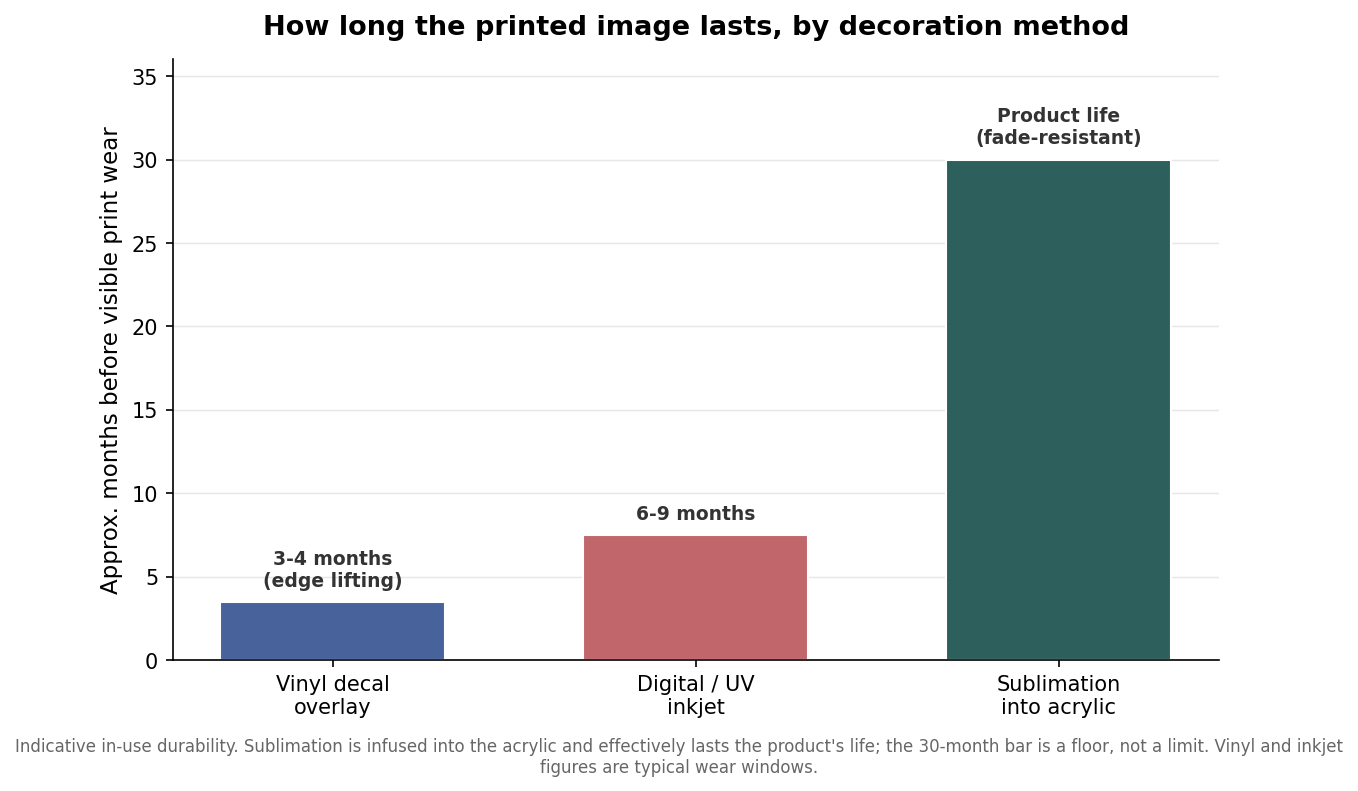
The chart is the case for thinking past the unit price. If a grip is a giveaway meant to last a single event or a single season, a shorter-lived method is not a flaw; it is a reasonable match to the lifespan you need. But if the point is a branded product people keep on their phone for a year or more, a decal that lifts at the edge in month four actively works against you, because a peeling logo reads as cheap. Match the print’s durability to how long you genuinely need the brand to stay visible.
The base and adhesive under the print
Decoration gets the attention, but two structural specs quietly determine whether the grip performs. The first is the thickness of the acrylic top. A range of roughly 3.2 to 3.8 mm tends to give the best balance of flex and strength: thinner tops are more prone to cracking, while noticeably thicker ones reduce how far the grip collapses and can make it wobble. The second is the adhesive on the base. A quality grip uses a strong industrial adhesive such as 3M VHB or an equivalent rated to hold under warmth and repeated pulling, which is what keeps the grip from creeping off a phone or case after a few weeks. A beautiful print on a weak base or a poor adhesive is a grip that fails in the hand regardless of how good the artwork is, so it is worth confirming both specs, not just the decoration method.
What longevity costs
The methods stack up in cost roughly in line with how long they last. Vinyl decals are the least expensive per unit, digital inkjet sits in the middle, and sublimated acrylic is the most expensive of the three. The figures below are indicative small-run prices to show the relationship rather than a quote, and the gap narrows considerably at promotional volumes, where per-unit costs for any method drop well below single-piece pricing.
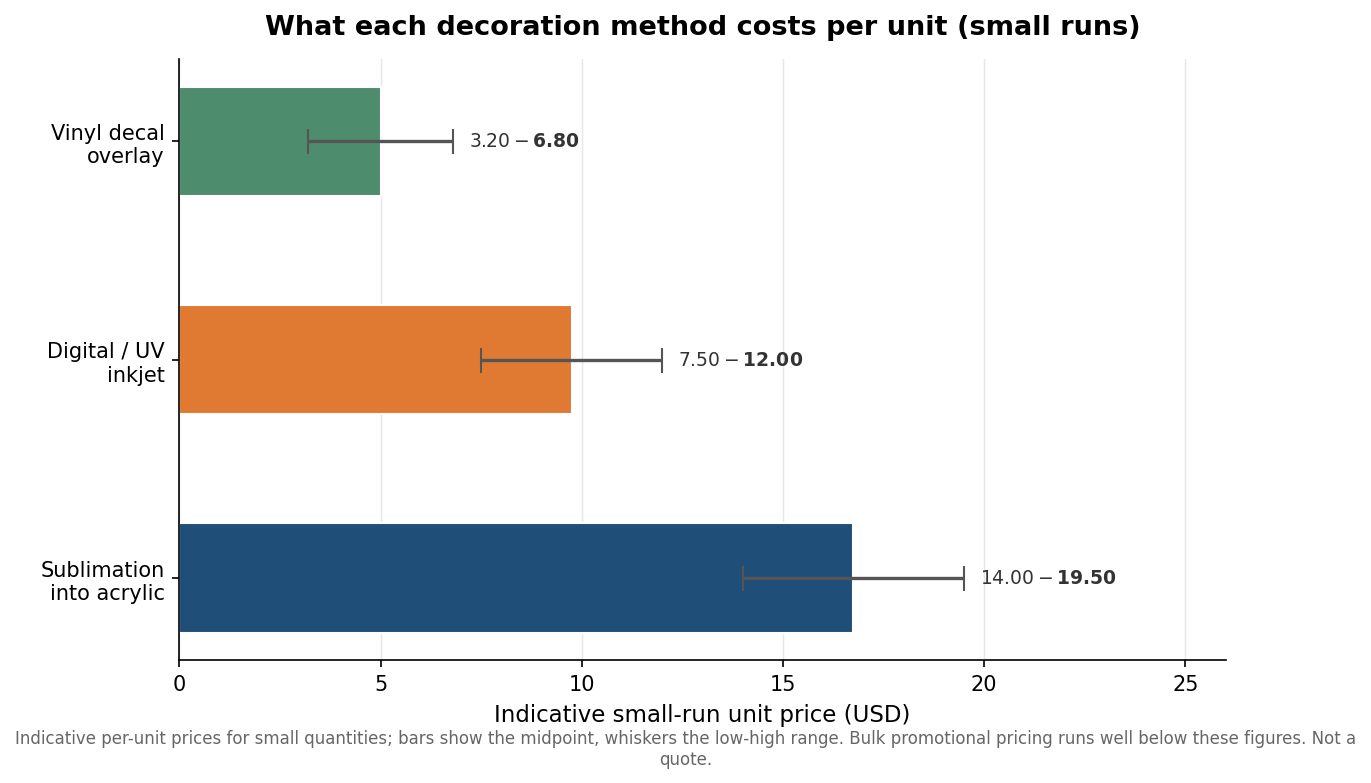
Read the price chart alongside the durability one rather than on its own. Sublimation costs the most per piece, but if it lasts the life of the product while a decal needs to be re-ordered or simply looks worn within a few months, the more durable method can be the better value for a keepsake despite the higher sticker price. For a one-event giveaway, the reverse is true: paying a premium for years of fade resistance on something people use for a weekend is spending on a lifespan the campaign will never use.
Choosing a method for your run
The decision comes down to how long the brand needs to stay visible and what you are willing to spend to get there. For a short promotional push, a trade-show handout, or a price-sensitive giveaway, vinyl decal or standard inkjet delivers a sharp look at the lowest cost, and the shorter lifespan is not a problem. For retail merchandise, premium event gifts, or anything a customer is meant to keep and use daily, sublimated acrylic protects the artwork for the long haul and looks the part. Whichever method you choose, confirm the base acrylic thickness and the adhesive spec, because those decide whether the grip holds up in daily use no matter how the image was applied.
The durability windows and prices here are indicative ranges drawn from how these methods behave in general, not fixed guarantees, and actual results vary with the specific supplier, artwork, and use. Treat them as a way to match the method to your campaign’s lifespan and budget, then confirm the details and get a quote for your exact quantity and design. The grips that disappoint are almost always the ones where the decoration outlived its welcome or wore out too soon for the job, and choosing the method by lifespan first is how you avoid both.
Leave a Reply