If you are choosing phone grips to put your brand on, the biggest decision is no longer color or finish. It is whether the grip snaps on with a magnet or sticks on with adhesive. That single choice decides whether the grip works with wireless charging, whether it fits your audience’s phones, and how it behaves in a pocket or a hand. Here is what actually changes between a MagSafe phone grip and a stuck-on one, and how to pick the right one for a branded run.
Magnetic or stuck-on: the choice that governs everything
There are two ways a grip attaches to a phone. A magnetic grip snaps onto the ring of magnets built into MagSafe iPhones and Qi2 phones, aligning itself automatically and holding by magnetism alone. An adhesive grip uses a stick-on pad that bonds to the back of the phone or its case and stays there. Everything else, from wireless charging to how easily a customer can move the grip, follows from that difference. The magnetic grip is removable and reusable; the adhesive grip is essentially permanent once it is placed.
How magnetic attachment actually works
A MagSafe grip carries a ring of around three dozen small magnets arranged to match the coil layout inside a modern iPhone, roughly 33 millimetres across. When you bring the grip close, it pulls itself into alignment and clicks into place. Because there is no adhesive, the customer can pop it off in a second, move it between devices, or take it off entirely to charge, and it leaves no residue. The catch is compatibility: this only works on phones built for it, which means iPhone 12 and newer, or an Android phone with Qi2 magnets. Older iPhones and most current Android phones have no magnets, so they need either a MagSafe or Qi2 compatible case or a stick-on magnetic ring to work with a magnetic grip, and those stick-on rings hold less reliably once the phone is in motion.
Wireless charging is where grips get in the way
This is the detail buyers most often miss, and it is the strongest argument for going magnetic. Wireless charging works by lining a coil in the charger up with a coil in the phone, and the magnet ring exists precisely to force that alignment. That alignment is why the magnetic standards hit the higher power ceiling.
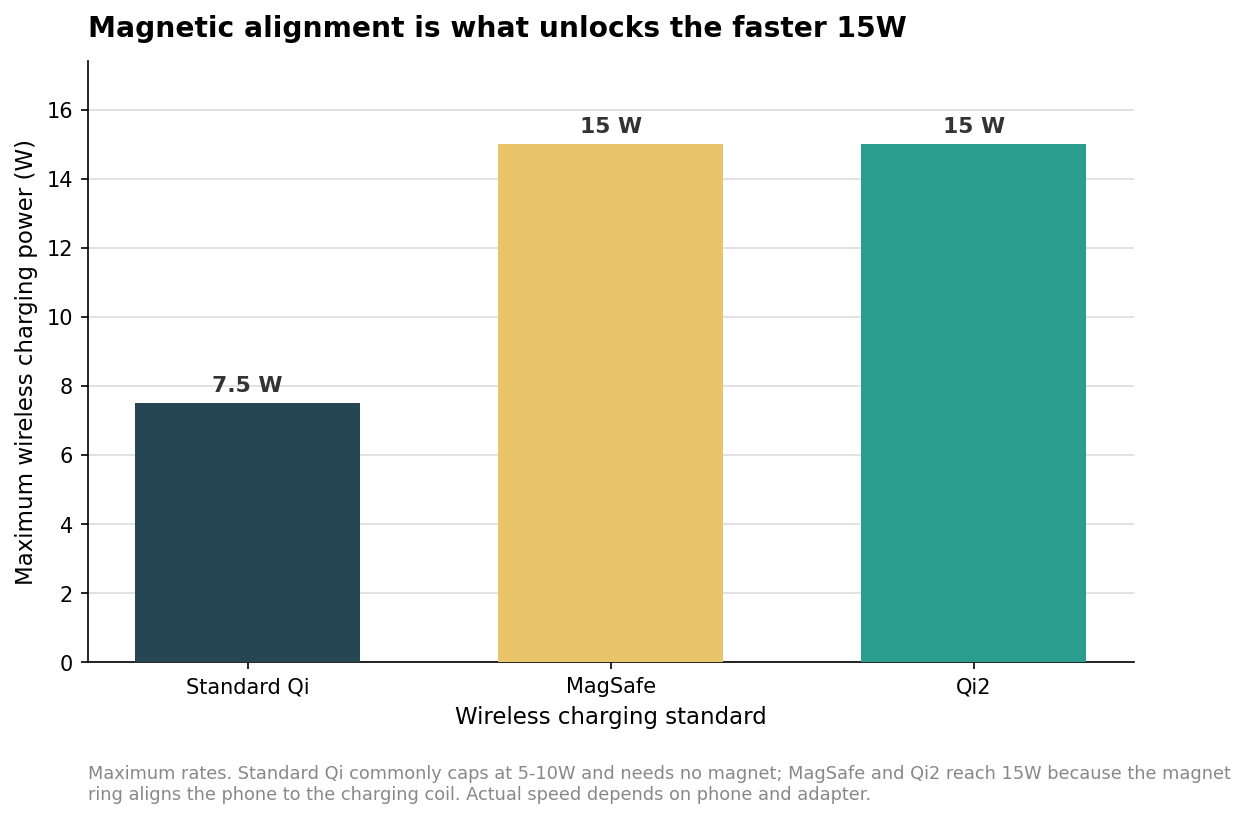
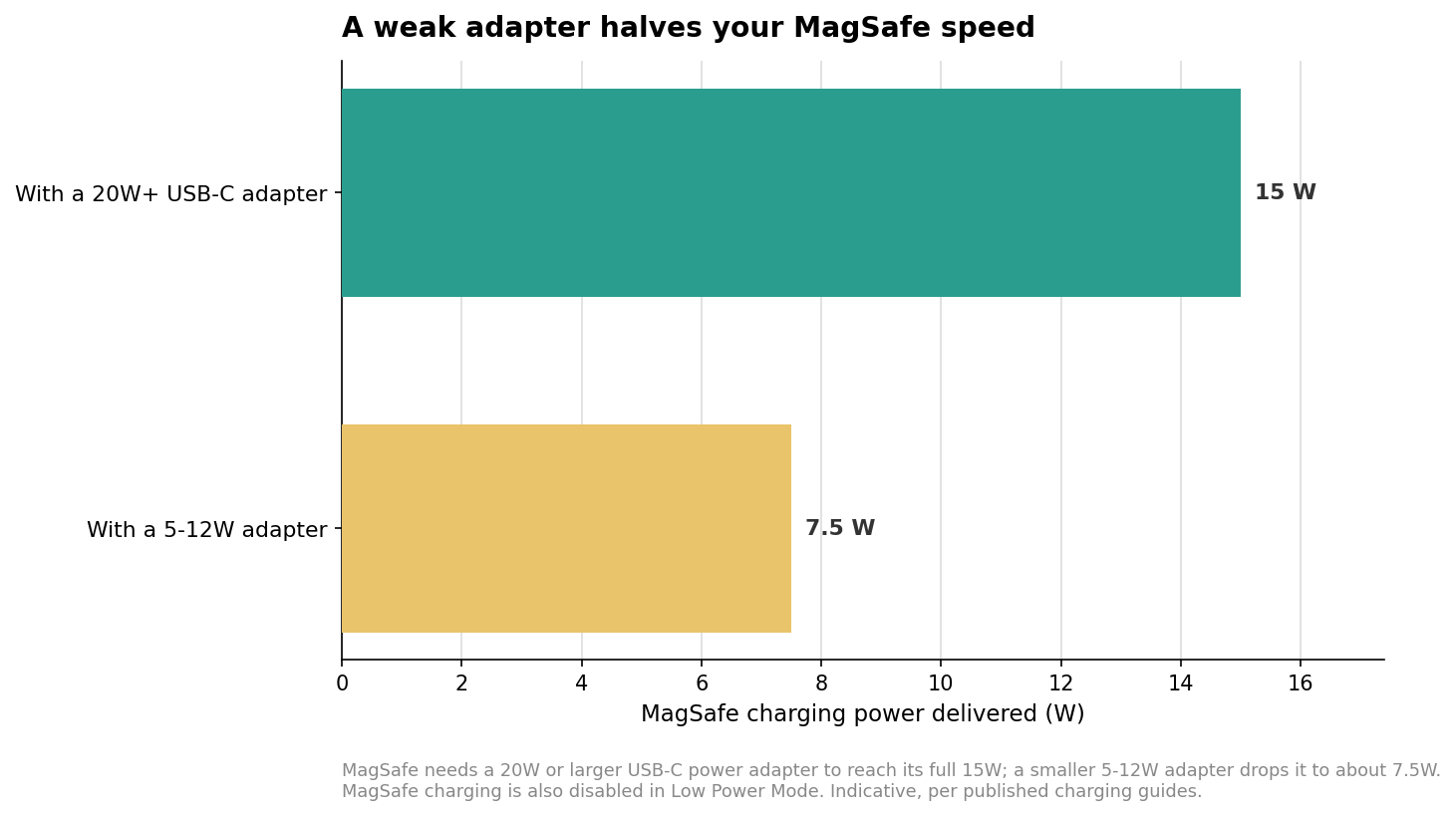
Standard Qi charging has no magnet and commonly tops out around 5 to 10 watts because the phone can sit slightly off-center. MagSafe and Qi2 both reach 15 watts because the magnets guarantee the coils line up. There is a second gotcha that surprises people: the wall adapter matters. MagSafe only delivers its full 15 watts with a 20-watt or larger USB-C adapter, and a smaller one cuts it roughly in half.
Now the grip’s role becomes clear. A magnetic grip sits on the same magnet ring a wireless charger uses, so the customer simply pops it off to charge, or in many designs charges straight through it. An adhesive grip stuck in the center of the phone sits directly over the charging coil and blocks it, forcing the customer to peel the grip off or give up wireless charging entirely. Adhesive grips mounted low or off-center, or ones with a hollow charging cutout, can dodge this, but a centrally placed pad and wireless charging do not coexist. For an audience that charges wirelessly, that is a real strike against plain adhesive.
Grip strength and the motion tradeoff
Magnetic attachment is not free of downsides. A well-placed adhesive pad bonds hard and does not move, which is reassuring when someone is dangling a phone one-handed over a couch. Magnetic grips hold strongly at rest but rely on magnetic force that can shear loose under active, dynamic movement, and slimmer low-profile magnetic designs give up some of that holding strength for the sake of a thinner build. In practice, magnetic grips are excellent for desk use, propping, and everyday handling, and adhesive grips give a bit more peace of mind for the most active, drop-prone use. Case thickness plays a part too: a thick or textured case puts extra distance between the magnets and the phone, which weakens the magnetic hold, so a customer in a heavy protective case may find a magnetic grip less secure than the spec suggests. If your recipients are hard on their phones or live in rugged cases, that is worth weighing against the charging convenience.
Which to offer for a branded run
For custom and promotional merch, the two attachment types suit different goals. Adhesive grips remain the most universal and usually the most economical choice: they stick to any phone or case regardless of brand or age, and their flat top is an excellent, uninterrupted canvas for a logo or full-color artwork. The tradeoffs are that they are permanent once applied and they interfere with wireless charging when centered. Magnetic MagSafe grips are the premium, modern option: reusable, charging-friendly, and satisfying to snap on, but they land best with an audience skewed toward newer iPhones, and they cost more per unit. The deciding factor is who is receiving them. A giveaway aimed at a broad, mixed-device crowd leans adhesive for universal fit and lower cost; a premium gift for a customer base you know is on recent iPhones leans magnetic. Whichever you choose, confirm the print area, decoration method, minimum order quantity, and lead time on a proof before you commit a full run, since those vary by grip type and supplier.
Leave a Reply